
Delays, Issues, and Ridiculous Costs Are Just Round the Corner
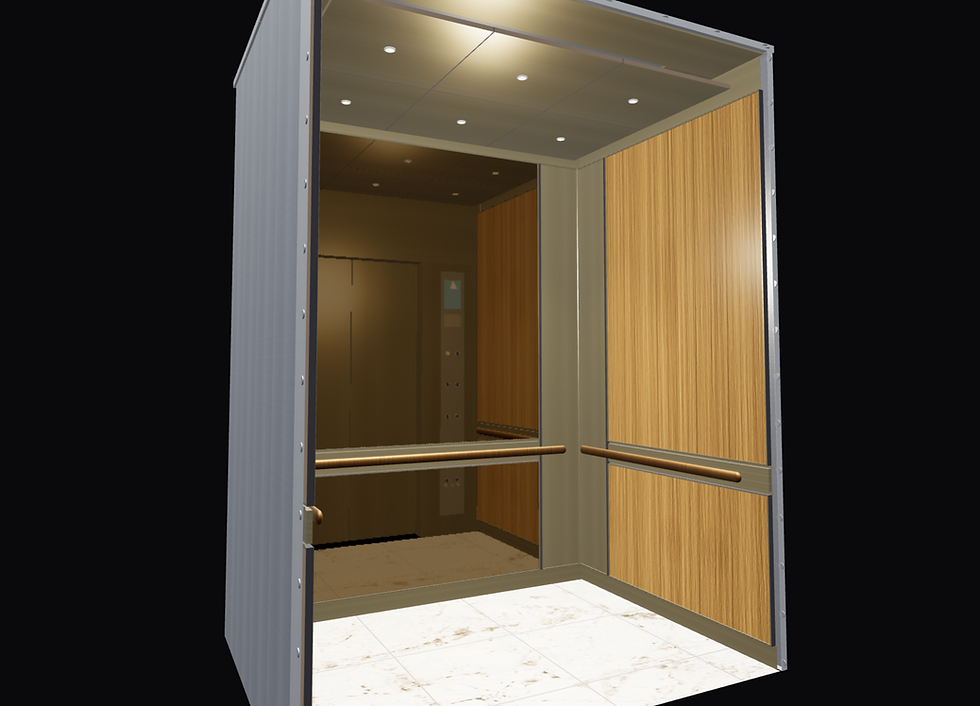
Every so often a rendering crosses my desk that makes the whole room lean in. Most recently it was a cab interior with rounded wall panels. No hard corners anywhere. The walls flowed into each other on a soft radius, the way the inside of a high end retail fixture does, and the effect was genuinely beautiful. Modern, fluid, expensive in exactly the way the client wanted to feel expensive. Everyone at the table loved it.
I love it too. Then I have to be the person who explains what that curve actually costs, because in an elevator cab a rounded corner is not a styling choice. It is a structural decision, and it is one of the most expensive few inches of geometry you can draw.
Here is the thing every architect needs to understand before they radius a single corner. A cab is never square. It looks square in the rendering and it looks square bolted up on the shop floor, but the moment it is hung in a hoistway and put into service it moves. It racks, it flexes, it shifts on its isolation. And during testing it does far more than shift. A full speed safety application or a buffer engagement subjects that car to sudden, violent load, and everything inside it has to survive that without coming apart. A cab is not a room. It is a moving machine governed by a safety code, and it gets treated like one.
A hard ninety degree corner with added panels separate of each other tolerates that movement. Two flat panels meet, and when the car works a little, the joint works with it. A rounded corner does the opposite. It rigidly ties two planes together across a curve, and when the cab moves, that curve has nowhere to give. So before you can even mount a radius, you have to square the cab out first. You build furring structure to true up the shell, you build the curved corner onto that, and then you have to isolate the whole assembly so the radius does not tear itself apart the first time the car is tested. That is hidden structure nobody sees and everybody pays for, and it exists purely to make a soft corner survive a moving machine.
That is all before we get to the material. This is where the budget really goes.
Take metal first. To radius metal properly you roll it. Rolling costs money and it costs lead time, but it gives you a clean, true curve. The cheaper path is to bump it by hand, and bumping leaves tool lines in the surface. Now you are either living with marks in a finish you were trying to make flawless, or you are paying for extensive additional grinding and finishing to blend them out, which frequently costs more than rolling would have in the first place.
Glass is worse. A curved glass panel is not something you order from anyone. It is custom bent glass, and there is a very short list of fabricators in this country who can produce architectural bent glass to cab tolerances. Short list means long lead and premium pricing, and if one panel breaks in five years you are back on that same list waiting again.
Stone surprises people. Stone in an elevator is almost never solid. It is thin stone veneer bonded to an aluminum honeycomb backing, because solid slab is far too heavy for a moving car that has to live inside its rated capacity and stay in balance. And veneer on honeycomb cannot be bent. So the only way to get a true radiused stone corner is to carve it out of a solid block, which drags the weight problem right back into the car and stacks the cost of carving stone on top of it. You wanted a soft stone corner. You just bought a heavy, hand carved one.
HPL is the trap. High pressure laminate is the cheap material, the one specified to save money. The second you curve it, the savings are gone. HPL has to be applied to a substrate, and a curved substrate is a built up, shaped substructure that costs far more than the laminate sitting on top of it. The finish is cheap. The thing you have to build to bend it is not. Fabric, leather, and material panels tell the exact same story. The material itself is not the cost. The curved substructure you have to wrap it over is, and you are paying for hidden shaping to carry a soft surface around a corner it was never going to make on its own.
So what happens when an architect does not know all of this going in. One of three things, usually more than one. The budget gets blown and the design goes back for redesign, which is delay stacked on top of cost. Or the weight creeps, especially with stone, and now the cab is fighting its own capacity and limitations. Or, worst of all, it gets built anyway, and then it fails in service. The joints open up as the car works. Panels shift, gap, and damage each other every time the elevator moves. The beautiful soft corner becomes a maintenance item that never stops, in a car that keeps coming out of service to chase it.
If the rounded corner is a must, and sometimes it genuinely is, here is how you do it with your eyes open. Go metal. Of all the curved options it is the least expensive and the least problematic, and it has one property the others do not. Metal can move with the cab without permanently deforming. Build reveals into the design on the sides of the curved panels, deliberate gaps that separate the wall panel from the structure and give the movement somewhere to go. Attach the curved structure to the shell behind them so the panel and the structure can move independently instead of tearing at each other. Done that way, the car works the way a car is always going to work, and the corner survives it.
Everything I just laid out is avoidable, and it is cheap to avoid. Brought in early, a cab consultant prices the radius, flags the furring and the isolation, catches the weight before the stone is ever specified, confirms the lead time on bent glass or rolled metal, and tells you whether the soft corner you fell in love with costs what you think it costs. Skip that conversation and the delays, the issues, and the ridiculous costs are all just waiting for you.
A curve in a rendering is free. A curve in a moving steel box is one of the most expensive things you can specify. Know which one you are actually buying before the design is locked. Let us work with you early to understand and properly specify. The right look, the best outcome and the right cab for you again... are just round the corner.
About Vertice
Vertice Elevator Cab Consulting, LLC is the only independent elevator cab consultancy run by someone who has personally sold, designed, engineered, fabricated, and installed cabs in New York's most prestigious buildings - Freedom Tower, the Empire State Building, the New York Stock Exchange, Rockefeller Center, and flagships for Gucci, Chopard, and Tiffany. Vertice provides independent design review, specification, value engineering, code-compliance coordination, and damage claim evaluation for architects, developers, building owners, and consultants.
Planning cab interior work? Talk to us before the first panel goes up.
Nick Gretsuk, Founder & CEO | Nick@VerticeECC.com | www.verticeecc.com | Serving New York, New Jersey & Florida

Comments